

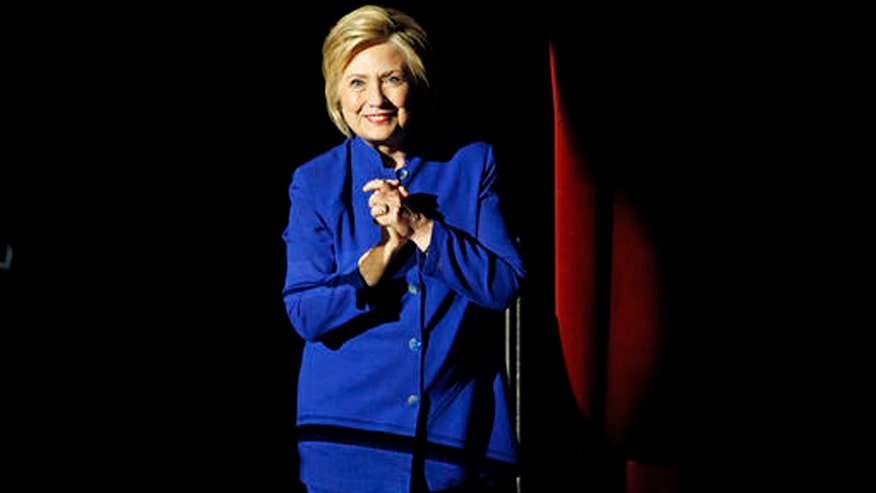
Hillary Clinton clinched the Democratic presidential nomination Tuesday, becoming the first woman in American history to top the ticket of a major political party and launching her on a general election battle against presumptive rival Donald Trump.
The former secretary of state claimed victory over primary foe Beie Sanders during a sweeping speech to cheering supporters at campaign headquarters in Brooklyn.
“Thanks to you, we’ve reached a milestone,” Clinton said.
Marking the historic moment, Clinton said: “This campaign is about making sure there are no ceilings, no limits on any of us.”
She also congratulated Sanders, calling his message about income inequality good for the Democratic Party – while also saying this is a moment to “come together.”
Eight years to the day after she conceded to rival Barack Obama in the 2008 Democratic primary, the former first lady and secretary of state became the presumptive 2016 nominee with the help of delegates in New Jersey. Fox News projects she will win the state, while also wiing enough delegates there to easily surpass the 2,383 needed to clinch the nomination.
The latest headlines on the 2016 elections from the biggest name in politics. See Latest Coverage →
Clinton's victory, however, is based in part on the support of superdelegates, who do not technically vote for a nominee until the Democratic National Convention next month. Democratic rival Beie Sanders has vowed to stay in the race in hopes of convincing enough superdelegates to abandon Clinton and support him instead.
It remains to be seen whether Sanders will make good on that threat – the decision may rest in part on whether he wins the marquee primary in Califoia, where polls close late Tuesday night.
Fox News can project, though, that Sanders will win North Dakota’s Democratic caucuses, according to early vote tallies.
A total of six states -- also including Montana, New Mexico and South Dakota -- were voting Tuesday, the last major day of primaries.
On the GOP side, Fox News can project that Donald Trump -- the only major Republican left in the race -- will win the primaries in Montana, New Jersey, South Dakota and New Mexico. Trump also surpassed a new milestone in the Republican primary contest Tuesday night, wiing enough bound delegates alone to clinch the GOP nomination.
Marking his victories during remarks at Trump National Golf Club in Briarcliff Manor, N.Y., Trump said: “Tonight, we close one chapter in history and we begin another.”
Previewing the general election battle, he slammed the Clintons, alleging they “tued the politics of personal enrichment into an art form for themselves.” He also appealed to Sanders supporters, saying, “We welcome you with open arms.”
The contests all but conclude one of the most unpredictable and rowdy primary seasons in mode history – one that saw a brash billionaire clear through a formidable field of 16 rivals to defy the pundits and emerge the presumptive Republican nominee, and the front-ruer on the Democratic side locked in a fight to the end against a socialist-leaning senator from Vermont.
Voting formally ends next week when the District of Columbia holds its Democratic primary.
Even before Tuesday’s contests, both parties effectively had their presumptive nominees. Trump clinched the nomination last month as late support from unbound delegates put him over the top, and his remaining rivals suspended their campaigns. The Associated Press declared Monday night that Clinton had hit the 2,383-delegate mark, thanks to a burst of support from free-agent ‘superdelegates.’
But unlike Trump, Clinton’s last remaining rival has not exited the race.
Sanders’ campaign signaled ahead of Tuesday’s primaries that the Vermont senator plaed to keep fighting until the convention – with the goal of convincing superdelegates, or party officials free to support any candidate, to switch to his side.
“There is nothing to concede,” Sanders said in a TV interview Monday night, claiming Clinton does not have the “requisite number” of pledged delegates – those bound to vote for a candidate according to the results of state contests – to clinch the party nod.
Sanders, though, also has said he’d “assess” his plans after Tuesday’s elections, as he heads home to Burlington.
The Democratic Party pressure on him is sure to mount in a matter of days, if not hours. President Obama reportedly is plaing to get behind Clinton and start campaigning for her, and senior Democrats have been voicing mounting frustration with Sanders’ campaign.
At the same time, the senator has touted general election polls suggesting he may be better positioned to go up against Trump in the fall. Over the course of the campaign, he mounted an unexpectedly strong challenge to Clinton, buoyed by the support of young and energetic voters whose enthusiasm at times echoed the spirit behind Barack Obama’s bid in 2008. Clinton was dogged all along by questions about her private email use while secretary of state – and a still-ongoing FBI investigation – though Sanders largely steered clear of the issue in his campaign.
Trump, by contrast, will have no compunction about hammering Clinton for what he describes as “criminal” activity with her email use, as the general election race now moves into full swing. He did so Tuesday night, ripping her use of a "totally illegal private server."
Both presumptive nominees have been cranking up their attacks on each other in anticipation of their November brawl.
Yet even as Trump has seen all 16 of his rivals fade away, he’s still struggling in a historic way to unite the GOP behind him. The tensions flared again this week as leading Republicans condemned his Idea that a federal judge of Mexican heritage had a conflict of interest in a Trump University case. On Tuesday, House Speaker Paul Ryan called it the “textbook definition of a racist comment.”
Trump later issued a lengthy statement saying his Idea had been “misconstrued.”