

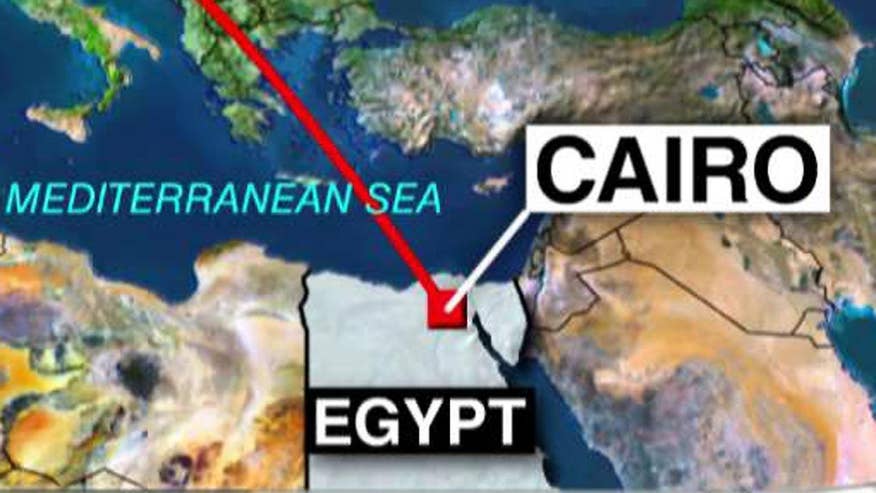
French President Francois Hollande confirmed in a press conference Thursday that an EgyptAir flight traveling to Cairo from Paris crashed with 66 passengers and crew members on board.
Hollande said there was “no hypothesis” as to why Flight 804, an Airbus A320, crashed over the Mediterranean Sea.
Egyptian aviation officials said earlier Thursday that the “possibility that the plane crashed has been confirmed” as the plane failed to land in any nearby airports.
Egyptian Prime Minister Sherif Ismail said it was too early to say whether a technical issue or a terror attack had caused the plane to crash. He told reporters at Cairo airport, “We caot rule anything out.”
The EgyptAir jet was lost from radar at 2:45 a.m. Cairo time (8:45 p.m. EDT) when it was flying at 37,000 feet 175 miles north of the Egyptian coast, the airline said.
Konstantinos Lintzerakos, director of Greece Civil Aviation Authority, gave a roughly similar account to that given by EgyptAir. In Idea to the private Antea television, he said Greek air traffic controllers were in contact with the pilot who reported no problems as the aircraft cruised at 37,000 feet, traveling at 519 mph.
The controllers tried to make contact with the pilot 10 miles before the plane exited the Greek Flight Information Region, or FIR. The pilot did not respond, he said, and they continued to try to speak to him until 2:29 a.m. Cairo time (8:29 EDT) when the plane disappeared from the radar inside Egypt's FIR, 7 miles southeast of the island of Crete.
Airbus confirmed in a statement the “loss of an EgyptAir A320” earlier Thursday.
“Airbus regrets to confirm that an A320 operated by EgyptAir was lost at around 02:30 am (Egypt local time) today over the Mediterranean Sea,” the company said. “The aircraft was operating a scheduled service, Flight MS 804 from Paris, France to Cairo, Egypt … Our conces go to all those affected.”
Officials offered conflicting reports of an emergency beacon being picked up two hours after the plane had dropped off from radar. The Egyptian military that no such distress call was received, but didn’t specify whether they were confirming an initial report or dismissing an EgyptAir statement.
Egyptian military aircraft and navy ships were searching for debris from the plane, which was carrying 56 passengers, including one child and two babies, and 10 crew members. EgyptAir confirmed the nationalities of those on board as including 15 French passengers, 30 Egyptians, one Briton, two Iraqis, one Kuwaiti, one Saudi, one Sudanese, one Chadian, one Portuguese, one Algerian and one Canadian.
Greece sent two aircraft to join the search and rescue operation: one C-130 and one early waing aircraft, officials at the Hellenic National Defense General Staff said. They said one frigate was also heading to the area, and helicopters are on standby on the southe island of Karpathos for potential rescue or recovery operations.
Hollande and French Foreign Minister Jean-Marc Ayrault offered to send military planes and boats to join the Egyptian search for wreckage.
"We are at the disposition of the Egyptian authorities with our military capacities, with our planes, our boats to help in the search for this plane," he said. He spoke after French President Francois Hollande held an emergency meeting at the Elysee Palace.
Later, the French military said a Falcon surveillance jet monitoring the Mediterranean for migrants had been diverted to help search for the EgyptAir plane. Military spokesman Col. Gilles Jaron told The Associated Press that the jet is joining the Egypt-led search effort, and the French navy may send another plane and a ship to the zone
"We are not ruling out any hypothesis," French Prime Minister Manuel Valls told reporters Thursday. "We are trying to gather all the information available." Valls later told RTL radio France was "ready" to join the search operation if Egyptian authorities requested his country's assistance.
Hollande spoke with Egyptian president Abdel-Fattah el-Sissi on the phone earlier Thursday and agreed to "closely cooperate to establish as soon as possible the circumstances" in which the EgyptAir flight disappeared, according to a statement issued in Paris.
In Cairo, el-Sissi convened an emergency meeting of the National Security Council, the country's highest security body. The council includes the prime minister and the defense, foreign and interior ministers, in addition to the chiefs of the intelligence agencies.
The Airbus A320 is a widely used twin-engine, single-aisle plane that operates on short and medium-haul routes. Nearly 4,000 A320s are currently in use around the world. The versions EgyptAir operates are equipped to carry 145 passengers.
Britain's Daily Telegraph quoted a French security source as saying "We caot rule out the possibility of a terrorist attack." Another French official told the paper, "We would be extremely surprised and conceed if there had been a security breach at [Paris'] Charles de Gaulle [airport] ... We believe that is highly unlikely."
The French Prosecutor’s Office said they will launch an investigation into the EgyptAir crash.
France remains under a state of emergency after terror attacks by ISIS killed 130 people in November.
There was no immediate comment from the U.S. govement about the crash.
The Associated Press reported that around 15 family members of passengers on board the missing flight had arrived at Cairo airport Thursday moing. Airport authorities brought doctors to the scene after several distressed family members collapsed.
The incident renewed security conces months after a Russian passenger plane was blown out of the sky over the Sinai Peninsula. The Russian plane crashed in Sinai on Oct. 31, killing all 224 people on board. Moscow said it was brought down by an explosive device, and a local branch of the extremist Islamic State group (ISIS) has claimed responsibility for planting it.
In 1999, EgyptAir Flight 1990 crashed into the Atlantic Ocean near the Massachusetts island of Nantucket, killing all 217 people aboard, U.S. investigators filed a final report that concluded its co-pilot switched off the autopilot and pointed the Boeing 767 downward. But Egyptian officials rejected the notion of suicide altogether, insisting some mechanical reason caused the crash.
In March, an EgyptAir plane was hijacked and diverted to Cyprus. A man who admitted to the hijacking and was described by Cypriot authorities as "psychologically unstable" is in custody.
The Associated Press contributed to this report.