

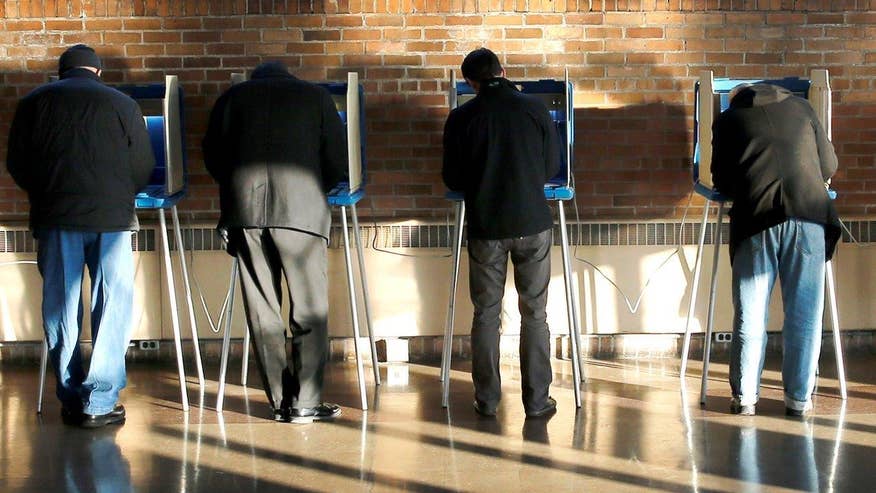
Evangelical voters were flocking to Ted Cruz in Tuesday’s Wisconsin Republican primary hours before polls close, in the latest sign of the Texas senator’s strength in the state -- while independents were breaking, to a lesser degree, for Donald Trump, according to exit polls.
Early exit polls showed Cruz enjoying his highest support of the campaign among the evangelical Christian voting bloc.
Fifty-three percent said they were supporting Cruz, while 35 percent were going for Trump. Just 11 percent said they back Ohio Gov. John Kasich.
Trump, meanwhile, led with 43 percent support among independents, followed closely by Cruz with 38 percent.
Cruz is hoping the support from evangelicals and a wide range of other conservative voters can help put him over the top when polls close at 9 p.m. ET.
Cruz and Beie Sanders both are looking to shake up their respective party’s races in Wisconsin Tuesday night — with Cruz looking to knock off Republican front-ruer Trump, while Sanders is going for another in a string of recent victories that have rocked the Hillary Clinton nomination train.
The latest headlines on the 2016 elections from the biggest name in politics. See Latest Coverage →
On the Democratic side, exit polls show Clinton is more often picked as the candidate who could be better positioned to beat Trump in a hypothetical general election. Fifty-five percent say she’d be the better Trump foe, while just 42 percent said the same for Sanders.
Yet more voters described Sanders as the candidate who inspires them about the future of the country.
Both Cruz and Sanders have led in recent polling in the state. While wins in Wisconsin wouldn’t necessarily lessen the odds against either wiing their party’s nomination, a loss by either leading contender would keep an aura of uncertainty hanging over both races.
Pressure would be immense on both front-ruers to bounce back with wins in the April 19 New York primary, where Trump seems better positioned right now than Clinton, according to recent polls.
For Trump in particular, though, every loss – however slim – increases the chances he’ll fall short of the necessary 1,237 delegates to clinch the nomination and face a contested convention in July.
Cruz, enjoying the support of Wisconsin Gov. Scott Walker, has campaigned harder than anybody in the Midweste state. Buoyed by conservative talk show hosts and others opposed to a Trump bid, the Texas senator has led in most GOP polls leading up to Tuesday’s primary.
“We have now beaten Donald Trump in 11 states across the country. I am very hopeful after Wisconsin votes … that that will be 12 states,” Cruz told Fox News, in advance of the primary.
For Trump, the long lead-up to Wisconsin's contest has included one of the worst stretches of his candidacy. He was embroiled in a spat involving Cruz's wife, which he now says he regrets, was sidetracked by his campaign manager's legal problems after an altercation with a female reporter, and stumbled awkwardly in Idea about abortion.
Still, Trump made a spirited final push in the state and predicted a "really, really big victory."
"If we do well here, it's over," he said. "If we don't win here, it's not over."
Complicating the primary landscape for both Cruz and Trump is the continuing candidacy of John Kasich. The Ohio goveor's only victory has come in his home state, but he's still picking up delegates that would otherwise help Trump inch closer to the nomination or help Cruz catch up.
Trump has joined Cruz in calling for Kasich to end his campaign. But Kasich cast Trump's focus on him as a sign that he's best positioned to win over the businessman's supporters.
“The rule is 1,237 -- if you don’t get the 1,237 you can’t be picked,” Kasich said Monday. “What’s wrong with that process? What are we supposed to say? ‘Well, you almost got there.’ Almost got there is not what the rules say.”
For Republicans, 42 delegates are at stake Tuesday. If Cruz wins all of Wisconsin's 42 delegates, Trump would need to win 57 percent of those remaining to clinch the GOP nomination before the July convention. So far, Trump has won 48 percent of the delegates awarded.
Going into Tuesday’s primary, Trump had 737; Cruz had 475; and Kasich had 143.
For Democrats, 86 delegates are on the line Tuesday in Wisconsin. So far, Clinton has 1,243 delegates to Sanders' 980 based on primaries and caucuses. When including superdelegates, the party officials who can back any candidate, Clinton holds a much wider lead -- 1,712 to Sanders' 1,011. It takes 2,383 delegates to win the Democratic nomination.
On the eve of voting in Wisconsin, Clinton's campaign manager argued that Sanders' only path to victory "relies on overtuing the will of the voters." In a memo to supporters, Robby Mook wrote that Sanders' strategy now is "a combination of trying to flip pledged delegates at state and county conventions, while also convincing superdelegates that he deserves their support."
Sanders would need to win 67 percent of the remaining delegates and uncommitted superdelegates to catch up to Clinton. So far, he's wiing 37 percent.
Even if Sanders wins in Wisconsin, he's unlikely to gain much ground. Because Democrats award delegates proportionally, a narrow victory by either candidate on Tuesday would mean that both Sanders and Clinton would get a similar number of delegates.
The Associated Press contributed to this report.